
The question of whether women lead differently from men or are women better leaders is being researched and being documented more than ever before. In last few years I have at least been hearing about the ‘100 most influential women’ and ‘Top 100 women in business’ kind of categories. Not to say that I am too happy with this entire market based notion of leadership and being counted as influential but at least now there is a more vocal discussion around this.
A recent study at Harvard school has stirred a lot of discussion around this. (https://blogs.hbr.org/cs/2012/03/a_study_in_leadership_women_do.html). Jack Zenger and Joseph Folkman of Harvard business school have certainly brought out a very pertinen t issue that needs to be thought over. The mere fact that this was the most read article of the past 30 days proves it’s relevance. The sample size is 7000 interviews using 360 degree interviews.
So what does this article say? The first finding shows that the majority of leaders (64%) are still men. And the higher the level, the more men there are: In this group, 78% of top managers were men, 67% at the next level down (that is, senior executives reporting directly to the top managers), 60% at the manager level below that. And this is quite a predictable reality, is it not?
Now let us look at the details of the findings in terms of the skill set.
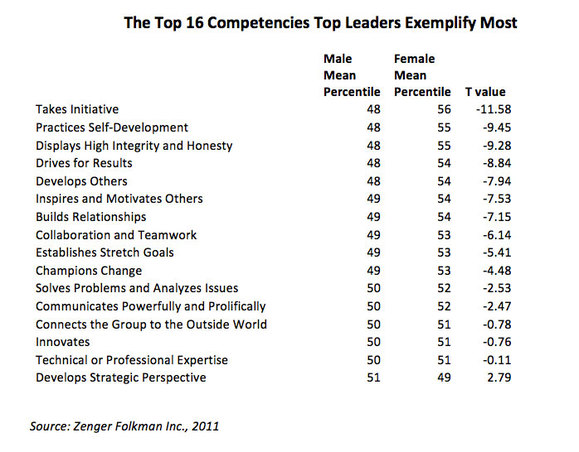
Now here is the list of competencies in which out of 16, 15 competencies where women are showing marginal to medium difference where women are better than men. And of course, the areas of these competencies are very diverse and range from the personal integrity and value based aspects, analytical ability, communication ability; to collaboration team work and mentoring abilities, to innovation as well as professional expertise. In a recent HBR blog post, they wrote:
“Similarly, most stereotypes would have us believe that female leaders excel at “nurturing” competencies such as developing others and building relationships, and many might put exhibiting integrity and engaging in self-development in that category as well. And in all four cases our data concurred — women did score higher than men.
“But the women’s advantages were not at all confined to traditionally women’s strengths. In fact at every level, more women were rated by their peers, their bosses, their direct reports, and their other associates as better overall leaders than their male counterparts — and the higher the level, the wider that gap grows.”
|
Now look at the responses and comments received. Overwhelming majority (men) rejects the study findings arguing, ‘may be because women are less in number, their achievements are highlighted’. One person even calls the survey method as ‘the beauty contest’ (weird eh??) One person in a completely dismissive way says, ‘This playground tactic of trying to show one side better than the other doesn't help the discussion, but only hurts. Only through both sexes, working together, utilizing their individual talents, will this country, this planet evolve. The battle of the sexes died in the 70s, we all won. Now let's get back to work.’ Some men also made a point that historically women have been clever and they have been guiding things behind the shadow of the men. Some women broke away from this pattern, though that does not make them a better (or worse) leader. I am now not going on with further writing down of all the responses. How very same pattern of stereotypes, arguments, denials and often accusations to prove the study wrong!! By saying this, I do not wish to defend whether the study is right or wrong, whether they employed correct methodology or not etc. Just one glance at the responses makes you wonder why so much of defensiveness?
There are three types of responses: (i) which rejects the study using all the same stereotypes that have been going rounds to not let women participate. (ii) Second set of people saying, we agree but this issue is not about gender, leave that aside and let’s talk about performance. (iii) And then there is the third group of responses who says women are better and they do face challenges in the work scenario.
Though I partly agree with the third category of responses, I have a different take on the issue. So here is my response to the study -
" Thank you Mr. Jack Zenger and Joseph Folkman for this study. What a pertinent issue! Thank you for voicing out through your data that women are better and women ARE being sidelined. I read all the comments to your article with equal interest as I read the article itself. And this beings me to one very basic question. I want to ask all those people (incidentally, most are men). Have you ever wondered why is it that time and again women are being asked to produce the proof of being 'better' than men? Even for getting their fair share they have to build a case for being better. And on the other hand, when they are stereotyped as 'not being better', then also the onus of responsibility is smartly shifted on women's shoulders. Quite clever of all those who do not want to see women in equal footing, eh!
Heck, who cares whether women are better than men or not. I want to be considered as good or as bad as men are and get my 50 % share in the world... How many men have the ability to treat women as equals!!???


 As I rush to finish my work and hurriedly pack my bags for the four months journey of learning at ‘Global Change Leaders Program’, a stream of thoughts goes on in my mind. On one hand is the excitement of meeting many new inspiring people, the opportunity to share about my work and the ‘change’ that I wish to see in this world, time for reflecting on my work so far and at the same time, the fear of leaving the work which is already going on at the jet speed and I do not want to loose out on that too!